The Clongownian
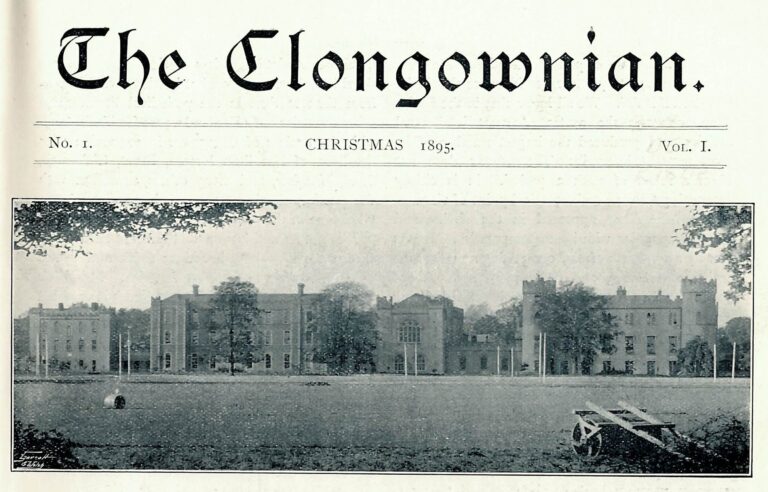
The first Editors of The Clongownian understood the importance of the job they were undertaking. The very first page of the first Volume gives some background: ‘The announcement that Clongowes is henceforth to publish a periodical record of its doings in a School Magazine of its own can scarcely come as a surprise to its friends. To them, indeed, the wonder has always been why something of the sort was not done long since. School journalism has become so common that it seemed not a little strange how Clongowes, with its past history and present performance, could have been content to remain so long without a chronicle. ‘
The Kildare Observer, December 14th, 1895, carried news of the new Magazine:

Along with the notice in The Kildare Observer, the Magazine carried a subscription insert:

Although it was a ‘first’, the Editor is at pains to point out that there were earlier attempts at a school Magazine. None of which, unfortunately, were in his possession: ‘A list of all the Clongowes Magazines, that have owed their birth to the enterprise of different generations, would be most interesting. Only six have come under the notice of the present Editor, but no doubt there are many alive who can supply the missing names. The list is as follows:

‘The Editor will be glad to receive any information on this subject, and will be most grateful for a copy…’ It is not clear from subsequent editions of the ‘Clongownian’, if this ever happened.
The ‘Round About Clongowes’ feature in Volume 1 covers The Rampart Of The Pale. As the author describes it: ‘The Rampart, [is] apparently nothing more than an ordinary “double ditch” with a bridle path on its summit…It seems strange-almost incredible-that in the fifteenth century this, not very formidable, fence was raised to mark and to defend the western limit of the British Empire.’ This feature is accompanied by some good quality contemporary photography.

Even in 1895, Clongowes had changed a lot in the eyes of past pupils. One article, ‘By An Old Clongownian’ is a mix of nostalgia and appreciation of improvements that have been made: ‘Clongowes has grown to be quite another place from what I knew it to be five and twenty golden years ago.’ The author recounts that, on a recent visit…’surprises awaited me everywhere. The study hall was quite a revalation. The dear old “study” of my boyhood days was gone forever.’ These are common sentiments for anyone who has ever visited their old school or college after a long absence.

Volume 5 went out at Christmas 1897. As the 100th Anniversary of the 1798 Rebellion was on the way, there was a palpable note of trepidation at how best to mark the occasion: ‘The announcement in the last number of the Clongownian, of a coming “special article” on the scenes around Clongowes in ’98, seems to have caused disquiet to one of our friendly critics. In a kindly notice of that issue, the Spectator expressed a hope that the promised contribution would not be too deeply imbued with patriotic feeling.’ The Magazine details the events that occured in Kildare in 1798, focusing especially on Colonel Aylmer, whose brother, Father Charles Aylmer, was the second Rector of Clongowes:

Quoting an historian of the Aylmer family, the author states that: ‘He [Colonel Aylmer] was one of the last of those soldiers of fortune whom Ireland has produced in such abundance; who used their swords against England at home, and when in exile devoted them to the service of foreign powers.’ After 1798, we are told: ‘…he entered the Austrian service…and met with rapid promotion, [he] commanded the escort that accompanied the Empress Marie Louise from Paris to Vienna after the fall of Napoleon.’ Many years after this ‘…when the Austrian cavalry was regarded as a model of perfection by the Continental states, the prince regent of England solicited from the Emperor the services of an experienced officer for the instruction of the British cavalry…and the officer whom he selected was Aylmer. Aylmer arrived in London, executed his commission, and was presented with a splendid sword of honour. But the prejudice of other times was revived when in the Austrian officer was recognized the rebel chief who, twenty years before, had marshalled the United forces on the plains of Kildare.’ One can only imagine the reaction of the prince regent to this Barry Lyndon-esque act of chutzpah.
Clongowes is of course also known for its famous past pupils. Two note-worthies from this era were James Joyce and Oliver St. John Gogarty. Joyce is mentioned in the Exhibition and Examination Results of 1894 and 1895 in The Irish Times, but he had decamped to Belvedere College by this stage, largely due to straightened family circumstances.
Gogarty, however, is mentioned in the pages of the early Clongownian, mainly for his sporting prowess. There is also a mention of an act of singular bravery. ‘Clongownians, of the last few years in particular, will have read with no little pleasure and pride the account of the gallant rescue by Oliver Gogarty of an unfortunate man who had fallen into the Liffey. It appears that Oliver was passing over Butt Bridge on his bicycle, when his attention was attracted by a large crowd. On going to the edge of the Quay, he perceived a man struggling in the water, and without a moment’s delay he plunged in to his assistance. Encumbered as he was with his clothes he had much difficulty in keeping the drowning man afloat, and probably would have lost his own life, had not one of the bystanders jumped in to his assistance with a life-buoy, and all three were brought safely to land.’ This is some very welcome good press for the man who has the dubious distinction of featuring in the very first sentence of Joyce’s Ulysses: ‘Stately, plump Buck Mulligan came from the stairhead, bearing a bowl of lather on which a mirror and a razor lay crossed.’ Joyce left a largely subjective and unflattering account of Gogarty.

The advertisements in The Clongownian also stand out. It looks to have been well sponsored, with over twenty pages of advertisements at the end of each volume.

There is also a testimonial given by The Carmelites, after the installation of ‘Sunlight Gas’ in the Carmelite Church in Kildare:

The Clongownian is in our collections in Kildare Local Studies. If you would like to view this Magazine, or any of our other collections, feel free to book an appointment with us.
Sources:
The Clongownian, 1895-1898
The Kildare Observer
By Kevin Dowling, Kildare County Archives and Local Studies.
