150th Anniversary of the Catalpa Rescue
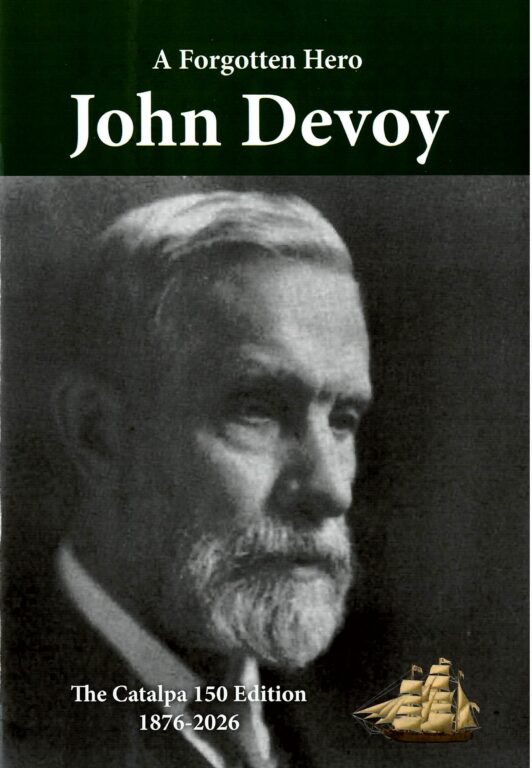
To commemorate the 150th anniversary of the Catalpa Rescue in 1876, Kildare County Archives and Local Studies and Kildare Libraries Commemorative programme present a detailed account of the escape by John Breslin, from the Cork Examiner which was originally published by the New York Herald. We have included this in a new edition of ‘A Forgotten Hero – John Devoy’ which we published in 2008 and we have also included a rare pamphlet from 1929, which was uploaded to Kildare EHistory in 2016 and can be found online here
There is also a brief account of the installation of the Memorial to John Devoy at Poplar Square in late 2015 and the donation of the John Devoy chair by Frank MacGabhann and its official handover to Kildare County Council in 2025. It is hoped this booklet will aid Leaving Cert students and others interested in researching John Devoy’s connection to his homeplace of Greenhills, Kill, Co. Kildare.
A ‘Catalpa 150’ A3 poster has also been printed as part of the commemorative programme. The booklet and poster are published with the support of the Department of Culture, Communications and Sport and Kildare County Council.
The following is the article as it appeared in the Cork Examiner, September 4, 1876.
THE ESCAPE OF THE FENIANS
(From the New York Herald)
The following remarkable story of the escape of the Fenian prisoners will be read with great interest. Its accuracy can be relied upon, and it is from the pen of the man who planned and successfully carried through the delicate enterprise:–
I started from New York on July 19,1875, and arrived in Freemantle on November 16. Rode to Perth the following day, and, finding Freemantle the best base for operations, determined to make it my headquarters. Engaged a room at the Emerald Isle Hotel, Patrick Moloney proprietor, and Desmond went on to Perth and found immediate employment in a carriage factory. Having learned during the following week that one of the Fenian ex-prisoners, named William Foley, was at large in Freemantle I made use of him to convey to James Wilson notice of my arrival and arrange our method of communication. The exploring expedition under Giles accomplished the overland journey, from Adelaide to Perth, the same week that I arrived in the colony, and, about the middle of December, I visited the prison, or, as they call it, in the colony, “The Establishment,” and, in company with two other gentlemen, was shown through the interior by the Superintendent; Mr. Donan, visiting all the corridors, both chapels, punishment cells, hospital, cookhouse, workshops and storeroom, and found it to be very secure and well-guarded. By the 1st of January, 1876, I had several interviews with Wilson and
DETERMINED THE PLAN FOR ESCAPE.
All the prisoners I wanted were working outside the prison and communication with them was comparatively easy, not expecting the Catalpa to arrive at Bunbury before the last week in January, and as some parties in Freemantle began to express surprise that I remained there so long without any ostensible business, I determined to take a trip inland, and accordingly visited Perth, Guilford, York, Northam, Newcastle and the smaller villages on the route.
January, February, and March passed by, and no sign of the vessel I waited for. The prisoners I wanted had been shifted around, communication with them had become difficult, and they were not so easily to be found when wanted.
About the end of March an American whaler named the Canton put into Bombay, and I telegraphed to her captain to know if he had any news of the Catalpa, of New Bedford. He replied that he knew nothing of her. I was now
BEGINNING TO GET ANXIOUS
about the vessel, and determined to go to Bunbury and wait there for some time. I expressed myself anxious to see that portion of the Colony lying between Perth and the Vasse, and on the 5th of March, engaged a seat by the mail car from Perth to Bunbury. On the 5th of March King arrived by the Georgette, bringing me gold from the organisers in New Zealand. Monday March 6 – Left Freemantle for Bunbury – distance, 120 miles. Remained in Bunbury until the following Saturday evening, when I returned to Freemantle by a small coasting vessel called the May. I remained in Freemantle, with an occasional visit to Perth, under the name of “Jones”, passing for a gold miner who had come to the colony on the reports of gold having been discovered in the North-west. Desmond remained all this time in Perth, working at his trade with an employer named Sloan, and was pretty well known as the “Yankee.” He came to Fremantle occasionally and saw me there.
March 29, 1876, 6.30 a.m. – Found by the telegraph bulletin board that the Catalpa had put into Bunbury the day before, March 28. As soon as the office opened, at ten o’clock, a.m., I telegraphed Captain Anthony:–
“Any news from New Bedford? When can you come to Freemantle?”
I received in reply in the afternoon: –
No news from New Bedford. Shall not come to Freemantle.
I engaged a seat by the mail car for Bunbury, and left Freemantle the following morning, arriving in Bunbury at four o’clock p.m., Friday, 31st. I met Captain Anthony ashore and explained to him what I purposed doing with the ship. He expressed himself perfectly willing to do what I required of him, but his crew were in a very discontented state and attempting to desert the ship. Four of them took a boat forcibly and made off for the bush. Three of those were brought back and put in irons on board, and the fourth was confined in the Bunbury lock up. The part of the coast I had selected for embarking from was distant from Freemantle about twenty miles south, at a place named Rockingham. It lies at the head of the sound, and a narrow passage at the end of Garden Island leads out to sea. I intended the Catalpa should stand well out to sea ten or twelve miles outside Garden Island, and a whale boat put into Rockingham and pull out to the ship, when we would get on board, a distance of fourteen to sixteen miles, which could easily be done under ordinary circumstances in four or five hours. I was anxious that the captain should see the coast outside of Rockingham and know exactly where his ship should be, so I arranged with him to come up with me to Freemantle by the Georgette, which was due in Bunbury with the Colonial mails on Saturday, April 1. By this arrangement the captain would have time to see the coast, know the spot where I intended to embark the men and be back in time to put to sea and leave me free to make the rescue on the morning of Thursday, April 6. Saturday evening, while waiting for the Georgette to leave for Freemantle, Thomas Brennan, who left New York to join the Catalpa at Fayal,
TURNED UP MOST UNEXPECTEDLY
as a passenger from Melbourne on board the Georgette. He recognized the Catalpa and came ashore to find out what he was to do. I had already more men than I could conveniently take to provide for, and again, he could not go on board the ship at Bunbury without exciting suspicion, so I determined to let him come on to Freemantle and then do the best I could for him. Sunday Morning, April 2, from the bridge of the Georgette, Captain Anthony had a good view of the coast outside Rockingham, and noted the positions of Rottnest, Garden Island and other principal landmarks. Arrived in Fremantle harbour, I found her Britannic Majesty’s gunboat Conflict carrying two guns and 30 men, schooner rigged and fast sailing, had arrived and anchored on the previous day. As the wind was for the most part light and variable and the Catalpa a dull sailer unless with a stiff breeze, the chance of escape from pursuit was too slim to be risked. So the presence of the gunboat upset my plan for Thursday morning. On the afternoon of Monday I learned that the gunboat came to Fremantle on an annual visit, would remain for eight or nine days and then proceed to Adelaide or Sydney; also that another gunboat was expected to call at Freemantle and take Gov. Robinson to visit the North-west. I asked Captain Anthony to overhaul his vessel, paint her and be in no hurry to get his wood and water on board, as we must wait until the gunboat sailed. I also explained to him the details of my plan, and drove him out to Rockingham that he might see and know the spot I intended to embark from. The road from Freemantle to Rockingham, for the first ten miles, is good for Western Australia. From the Ten Mile Well to Rockingham Hotel, about six miles, heavy and cut up with sand patches; from the hotel to the beach, about four miles, a mere track to the sand and bush. We made the distance in two hours and twenty minutes.
THURSDAY, APRIL 6 – Captain Anthony left Freemantle for Bunbury and I arranged to telegraph to him as follows: – When the gunboat had sailed, the telegram. “Your friend (N. or S., meaning north or south) has gone home. When do you sail?” This meant, “The gunboat has sailed north or south; all right; start for Bunbury.” In case the gunboat to take the governor to the northwest should arrive I would telegraph, “Jones is going overland to Champion Bay; did not receive a letter from you,” meaning “All right again.”
TUESDAY, APRIL 11 – The gunboat Conflict sailed from Freemantle, and I learned that she was bound for Sydney. At 10 o’clock a.m. I telegraphed to Captain Anthony “Your friend S. has gone home. When do you sail?” I expected an answer that he would sail that afternoon, and we would start on Thursday morning, April 13.
WEDNESDAY, APRIL 12, 11.30 A.M. – Received the following telegram:– “I sail today. Good-by. Answer if received. G. Anthony.”
This sailing, according to our arrangements, would leave the ship ready for my leaving with the men on Friday morning, and Friday being Good Friday, a government holiday, I could not do so. I immediately telegraphed, “Your telegram received. Friday being Good Friday, I shall remain in Freemantle and start for York on Saturday morning. I wish you may strike oil. Answer if received.” At half past seven, p.m., I received the following telegram:– ‘’ Yours received. Did not leave today. Wind ahead and raining, sail in the morning. Goodby”.
This fixed the start for Saturday morning, and I made all my arrangements to be ready to leave. I had an interview with Wilson shortly after the arrival of the Catalpa, and arranged a signal I was to make to him, which meant “Get ready; we start to-morrow morning.” This signal I could give on Friday, but I had a letter conveyed to him on that morning and an answer that he had received it. This letter contained, all necessary instructions, and concluded with the words, “We have money, arms and clothes; let no man’s heart fail him, for this chance can never occur again.” Desmond came to Freemantle from Perth with a good pair of horses and a four wheeled wagon on Friday evening, and I had a similar conveyance and the best pair of horses I could get to Freemantle engaged for Friday and Saturday. I took the horses out for a drive on Friday afternoon to be sure that they went well together and were in good condition, and on my return to my hotel found the following telegram waiting for me:–
Freemantle 14. 4. ‘76, 3 p.m. – From Banbury, J Collins, Esq.:–
It has blown heavy. Ship dragged both anchors. Can you advance more money if needed? Will telegraph again in the morning.
- ANTHONY.
By a fortunate chance Cranston had been sent from the prison into this town with a message that evening; had the telegram read to him, and my order of the morning countermanded. I thought the ship, having dragged both anchors, must have gone on the bar and a delay of some weeks would follow before she would be ready for sea again. Sent Desmond back to Perth again and prepared to wait the turn of events.
Saturday, April 15, half past ten, a.m., received the following telegram:–
I shall certainly sail today. Suppose you will leave for York Monday morning. Good by.
- ANTHONY.
I immediately replied:–
Your telegram received. All right. Glad you got off without damage. Au revoir.
- COLLINS.
I then engaged the same horses for Sunday and Monday and sent King to Perth on a horse I bought some months before to give Desmond notice to get his team and come to Fremantle on Sunday evening. Saturday afternoon I walked to the jetty, and when I was sure Wilson saw me I gave him the signal which meant, ” We start tomorrow morning.” The following morning being Sunday I saw he was somewhat puzzled; so keeping him in sight I walked leisurely across where the prisoners were working and sufficiently near to say, “Monday morning,” without being observed by the Warden or any of the other prisoners.
EASTER SUNDAY.
Desmond came to Freemantle about two o’clock p.m., with a very poor looking pair of horses, the former pair having been engaged to go to York when he returned them on Saturday. He offered the hostler £2 to get him a good pair, but they were all engaged. I then went to get the horses I had engaged and found that Albert, the owner, had given the best horse of the pair to Mr. Stone, the Superintendent of Water Police, to go to Perth with, his brother-in-law, the Sheriff, having been thrown from his horse in Perth and lying in a critical condition. Albert also informed me that I could not have the horses I had engaged on Monday morning, that his clerk had done wrong in hiring them to me, as he himself had promised them to Mr. Thompson a week before to go to the Perth Regatta on Easter-Monday.
MONDAY, APRIL 17. – At half-past five A.M. I had the hostler called and the valise put in the trap, waked up King and Desmond – Brennan was already wake and dressed – and left for Rockingham, at six a.m. At seven o’clock a.m., I went to Alber’s stables and found the pair of horses I wanted and a nice light four-wheeled trap already harnessed up and waiting. I told the hostler to let them stand for about twenty minutes, and then went and told Desmond to get his horses harnessed up and be ready to leave at half-past seven a.m. I had arranged with Desmond for him to leave Freemantle by a side street, which after a few turns took him on to the Rockingham-road, whilst I drove up High Street, as if going to Perth, turning sharp round by the prison and on the same road. King, being well mounted, was to remain after we started for a reasonable time, and then to follow and let us know if the alarm was given. At half-past seven a.m., I drove slowly up the principal street, and turning to the right, walked my horses by the warder’s quarters and pensioners’ barracks. The men were beginning to assemble for parade. I had arranged with our men that I would have the traps in position on the road at a quarter to eight, and would remain so, the nearest being within five minutes’ run of the prison, until nine o’clock, a.m. Being ahead of my time I drove slowly along the Rockingham Road, and Desmond, coming up shortly after, drove by me. Coming to a shaded part of the road, we halted, and having divided the hats and coats, three of each to each trap, I commenced to drive back to Freemantle. Desmond following; time, five minutes to eight. A few moments after I saw three men in the prison dress wheel round and march down the Rockingham Road. Driving up to them I found the men were Wilson, Cranston, and Harrington. I directed them to pass on and get into the trap with Desmond and drive away. Desmond wheeled his horses round and they were only seated and ready to start when the other three came in sight and driving up to them I found one man carrying a spade and another a large tin kerosene can. As soon as I came near enough to be recognised he who carried the spade flung it with vim into the bush and the holder of the kerosene can bestowed a strong kick upon it in good football fashion. I found the men were Darragh, Hogan, and Hassett. I now had all the men I wanted and felt glad. My horses got restive and refused to wheel around. Darragh caught one by the head, but he jibed and kicked so I was afraid he would break the harness, I told Darragh to let him go, and, whipping both of them up smartly, they started fairly together, and when I got them on a wider part of the road they wheeled round nicely. I now drove back and took up my men. Desmond was already well out of sight, and King shortly rode up and told me all was quiet when he left.
With regard to the method or plan of communication between the prisoners themselves it may be well to state that their good conduct and length of imprisonment had entitled them to the rank of constable, which enabled them to communicate with each other with greater ease and freedom than the other prisoners. Wilson and Harrington worked in the same party at the construction of harbour works in Freemantle. Hogan was a painter by trade, and on the morning of the escape was employed painting the house of Mr. Fauntleroy, outside the prison walls. Cranston was employed in the stores and as messenger occasionally. Darragh was clerk and attendant to the Church of England chaplain and enjoyed considerable facilities for communication with the other prisoners, and on the morning of the escape took Hassett with him to plant potatoes in the garden of Mr. Broomhole, the clerk of works for the convict department. After breakfast on the morning of the 17th of April all the political prisoners were engaged outside the prison wall. Cranston passed out as if going on a message, and having overtaken the warder, who was marching the working party in which Wilson and Harrington worked, showed him a key and told him he had been sent to take Wilson and Harrington to move some furniture in the Governor’s house, which was the nearest point to where they expected to meet me. The warder told Wilson and Harrington to go with Cranston and they marched off. Darragh took Hassett, as if going to work, in the same direction, and was joined by Hogan, who made an excuse for temporary absence to the warder who had charge of him. Both parties met at Rockingham Road.
I now drove on, letting King fall behind, and in half an hour was close behind Desmond. We held on without accident or incident until we reached the Rocking Hotel, when Somers, the proprietor, who knew me, called out to know what time was the Georgette expected to be at the timber jetty. I told him the Georgette was at the jetty in Freemantle when I left, but I did not know when she would be at Rockingham. At half-past ten a.m. we made the beach and got aboard the whale boat. The men had been instructed to stow themselves in the smallest possible space, so as not to interfere with the men at the oars, and in a few moments, all was ready and the word was given.
” SHOVE OFF, MEN; SHOVE OFF.”
Now fairly afloat the word was, “Out oars and pull for your lives!” “Pull as if you were pulling after a whale!” The boat’s crew were somewhat disconcerted and scared at the sudden appearance of so many strangers armed with rifles and revolvers, and pulled badly at first, but the voice of the steersman rallied them, and the cries “Come down, Mopsa,” ” Come down, you big Louis;” “Pull, Toby, pull; ” “Give them stroke, Mr. Silver;” “What do you say, men,” “Come down altogether;” ” Pull away, my men, pull away,” soon warmed them to their work, and they fell into stroke and pulled well. When about two miles off shore we saw the mounted police ride up to the spot where we had embarked, and then slowly drive the horses and wagons we had used up the beach toward the Rockingham jetty. I now remembered a letter which I had addressed to the Governor, and fastened it to some wood sufficient to float it well, I posted it to him by the ocean mail; as we were well inside Garden Island and the wind and the tide setting full on shore, I have no doubt it reached its destination. The letter read as follows:–
ROCKINGHAM, April 17, 1876.
“TO HIS EXCELLENCY THE BRITISH GOVERNOR OF WESTERN AUSTRALIA:–
“This is to certify that I have this day released from the clemency of Her Most Gracious Majesty Victoria, Queen of Great Britain &c., six Irishmen condemned to imprisonment for life by the enlightened and magnanimous government of Great Britian for having been guilty of the atrocious and unpardonable crimes known to the unenlightened portion of mankind as “love of country” and “hatred of tyranny.” ‘For this act of “Irish assurance,” my birth and blood being my full and sufficient warrant. Allow me to add that–
In taking my leave now, I’ve only to say,
A few cells I’ve emptied, a sell in its way.
I’ve the honor and pleasure to bid you good day–
From all future acquaintance excuse me, I pray.
In the service of my country.
“JOHN J. BRESLIN”
At half past twelve we were clear of the reefs seaward of Garden Island and, hoisting the boats’ sails stood away to the southeast in search of the ship; held on this course until four o’clock, p.m., when, there being no sign of the ship, we took in sail and rowed to the westward; about half-past five p.m. Toby raised the ship about 15 miles ahead of us and the men bent to their oars in order to get as near to her as possible before dark; at half-past six we had gained on the ship and could see her topsails quite plain from the crests of the waves; made sail on the boat. At this time the weather had become gloomy, with rain squalls, and we were all pretty thoroughly soaked. The boat made good headway under sail and we were rapidly overhauling the ship, carrying all sail and the whole boat’s crew, sixteen men in all, perched on the weather gunwale, with the water rushing in from time to time on the lee side, when, about seven o’clock a squall struck us, carrying away the mast, which broke short off at the thwart and by the time we had the mast and sail stowed away the ship had disappeared in the increasing darkness. We pulled in the direction of the ship until about ten o’clock with the hope of being able to see her lights, but without success. We then hoisted the jib on an oar and steered the course we supposed the vessel had gone. There was an ugly sea running, and the weather threatening to become more severe. However, towards morning, it moderated considerably. At quarter to seven a.m., we raised the ship and steered for her. She was coming toward us and we could see her lower sails, when on looking behind,
I SAW THE SMOKE OF A STEAMER,
and soon after was able to make out the Georgette steaming out from Fremantle, with all sail set. It was her regular day for sailing to Albany, with and for the Colonial mails, and for a short time we were in doubt whether she was in pursuit or going on her regular trip. A little further observation convinced me that she was too far out of her regular course to be going to Albany, and a slight alteration in her steering decided the question, showing us that she was making for the Catalpa, which she must have seen before we did. We now plied oar and sail to reach the ship, but it soon became apparent that the Georgette was gaining too fast on us and would fetch the ship much sooner than we could. She was also coming close enough, to make us out, under sail, so we determined to take down the sail and lie to, taking the chance of her passing by without seeing us. The Georgette passed without having seen our boat, steering direct for the Catalpa, now distant about five miles. As soon as she had passed far enough ahead we pulled after in her wake, judging it to be the safest position we could occupy if she was in search of us, and also bringing us nearer to the ship. Situated thus, we saw the Georgette run alongside the Catalpa, and after remaining alongside about ten minutes, steamed slowly away, the ship holding on her course, and the Georgette steaming in the same direction, but gradually sheering off and going more in shore. It was now about half-past eight a.m., and we made all the sail we could, and put every oar and paddle to overtake the ship. The ship held on her course on the wind, heading south-east, and both the ship and the Georgette kept increasing their distance from our boat. About halt-past eleven a.m., watching the ship and the steamer alternately, the ship being about twelve and the steamer about eight miles distant, I noticed the steamer heading too close in shore to be on her course for Bunbury, where we thought she was bound after parting the Catalpa. Observing her movements more closely we shortly afterwards saw the steamer turn right round, and heading for Freemantle, come under steam and sail along the coast, evidently in search of our boat. We were now almost in the steamer’s track, and if she stood out to sea a little could
SCARCELY HOPE TO ESCAPE UNOBSERVED
However, we still struggled on in the course the Catalpa was sailing, although she was fast receding from our view, and some of our men began to call her the phantom ship as the more we strove to approach her the farther off she appeared to sail. The Georgette now began to get dangerously close to our boat and we took down our temporary mast and sail but continued to work our oars and paddles. The Georgette still continued to come closer, and we had but slight hopes of escaping unseen. We lay as low as possible in the boat, ceased rowing for a short time. About half-past twelve, p.m., the Georgette passed across our wake so close, that we could distinguish men on her deck and a lookout man on her masthead. For a time I expected to see her turn and bear right down on us, but she passed on, and as soon as we sunk her hull we made sail again, and stood after the Catalpa. We now commenced to gradually gain upon the ship, which continued to loom up larger, and about two p.m., we saw that the Catalpa had altered her course and was coming toward our boat. I placed Wilson in the bow of the boat holding aloft a blue flag, and about half-past two p.m. felt certain that we were observed from the ship, as she was now headed directly for our boat. About the same time we saw another boat under sail making for the ship, and about equally distant from the ship on the land side as we were to seaward. A few minutes more and we recognised the boat as the water police cutter, and it now became a race which boat should reach the ship first. At three p.m. we ran up to the ship, on the weather side, the police boat being close up on the lee side, and scrambled on board in double quick time. As soon as my feet struck the dock over the quarter rail Mr. Smith, the first mate, called out to me, “What shall I do now. Mr. Collins? What, shall I do?” I replied, ” Hoist the flag and stand out to sea”, and never was a manoeuvre executed in a more prompt and seamanlike manner. The Stars and Stripes were flying at the peak, our boat was hoisted and in its place at the davits, the ship wore and was standing on her course inside of two minutes. The police boat was dropping alongside. As we went past I stepped to the rail and kissed my hand to the gentlemen who had lost the race. Their boat dropped astern and their officer shouted, “Goodbye, Captain goodbye.”
Twenty-eight hours in an open boat, with a liberal allowance of rain and sea water, cramped for want of room and cheered with a glorious uncertainty as to whether we should gain freedom or the chain gang; a suit of dry clothes, a glass of New England rum and a mug of hot coffee were just the things to put “where they would do the most good,” and were put accordingly. After supper we walked about the deck and enjoyed what we supposed to be a last look at the shores of Western Australia, the ship working to windward with a light breeze in the direction of Cape Naturaliste.
All hands except the watch on deck retired for the night about nine o’clock, p.m., and slept soundly. At five a.m. I came on deck and found the ship’s course had been altered and we were working to windward on a light breeze, steering north northwest, which would bring us past Fremantle again outside Rottnest Island; about half-past five o’clock the man on the lookout reported a sail on the lee bow. I thought when I first saw her she was a small coasting vessel, but Mr. Smith quickly pronounced her to be the Georgette. As the daylight advanced we saw that he was right; it was the steamer Georgette standing across our course and evidently in search of us. About six a.m. we passed the Georgette, she lying about half a mile to windward of us, with a man-of-war ship and vice admiral’s flag flying. We set the Stars and Stripes as we passed and held on our course. The Georgette turned and followed us, still keeping to windward. The breeze freshened about seven and the Catalpa began to drop the Georgette astern. They then fired up and made all sail on the Catalpa and, the breeze dying away, they began to overhaul us very fast. At a quarter to eight o’clock the Georgette was so near that I could see she had guns, an artillery force, and the water police on board; a whaleboat belonging to the water police hung at her davits, to be used in boarding; and they seemed quite eager and determined to capture us. The men of our party were all assembled in the cabin with their
RIFLES AND REVOLVERS READY.
Of the watch not a man visible from the Georgette but the lookout and the man at the wheel. I now stepped down into the cabin and explained to the men the position in which we stood. I told them that if the officials on board the Georgette were determined to fight for their recapture they would most probably succeed, as they had the advantage of us in every way — more men, better armed, cannon, and a steamer with which they could sail round and round us. I also explained to them that, whilst those of our party who had not been in prison could only suffer imprisonment, the men who had been imprisoned could be hanged in case any life was lost by their resistance. I then said it was simply a matter of dying now or waiting to die in prison, and gave them the option of fighting or surrendering if the officials in the Georgette fired into or boarded us.
Their answer was
“WE’LL DO WHATEVER YOU SAY.”
I then said, “I’ll hold out to the last,” and went on deck again. The Georgette was now very close on the weather side, with a company of artillery on board, a field piece pointed at our ship and the gunners at their quarters. At eight o’clock a.m., the Georgette steamed ahead and fired a round shot across our bows. Captain Anthony then put a question to me, to which I replied:—”Hold on and don’t take any notice of the shot yet.”
After the lapse of about three minutes, the artillerymen having got through all the regulation motions of springing out, reloading and pointing their piece, and the steamer and the Catalpa sailing side by side, within easy speaking distance, I said, “Now ask him what does he want.”
Captain Anthony stepped on the weather rail and raised his speaking trumpet. As he did so the Georgette hailed “Bark ahoy!” and the answer went back, “What do you want?” ” Heave to!” come back from the Georgette. “He says heave to.” ” Ask him what for.” “What for?” shouted our captain through his trumpet. No reply, and the question is repeated still louder
“WHAT AM I TO HEAVE TO FOR?”
After quite a pause the Georgette hailed, “Have you any convict prisoners on board?” Answer. “No prisoners here; no prisoners that I know of.” The Georgette then hailed, “I telegraphed to your Government; don’t you know that you are amenable to British law in this colony? You have six convict prisoners on board. I see some of them on deck now.” I then said to the captain, “This fellow is lying and trying to bluff us; he can’t send a message to Adelaide before Saturday next.” The Georgette then hailed, “I give you fifteen minutes to consider and you must take the consequences; I have the means to do it, and if you don’t heave to I’ll blow the masts out of you.” “Tell him that’s the American flag, you are on the high seas; if he fires on the ship he fires on the American flag.” The captain then shouted, pointing to his flag, “That’s the American flag; I am on the high seas; my flag protects me; if you fire on this ship you fire on the American flag.”
The threat to fire on the flag highly incensed the first mate, Mr. Smith. He damned the scoundrel in good, strong, nautical phrase, and he exclaimed “Damn him; let him sink us; we’ll go down with the ship. I’ll never start sheet or tack for him.” Mr. Smith now asked me, “What will we do if he tries to board us?” I replied, “Sink his boat when it comes alongside; you have a couple of good heavy grindstones; let us have them handy to heave over the side.” The captain now reminded Mr. Smith of some short heavy logs of timber which were in the hold and bade him order the crew to pass them on deck. These logs were quickly passed on deck and laid on the main hatch ready for use. The lookout reported a sail on the lee bow, and we saw a small sail between us and Rottnest Island. This called the captain’s particular attention to the position of our ship, and judging that we were coming too close into the land and liable to run into British waters, he wore ship and stood on the other tack, bearing down close on the Georgette which backed out of our way. This movement seemed to disconcert the parties on board the Georgette. Our fifteen minutes grace and several other minutes had expired, and as the Georgette steamed slowly across our stern, I looked for a raking shot across our masts. She did not fire, and as she ranged alongside again I knew that the game of bluff was played out. The party on board the Georgette with a battery of glasses and their spokesman, whom I believed to be Colonel Harvest, called out, “Won’t you surrender to our Government?” No reply, and again he called out, “I see three of those men on hoard now.” Our captain replied, “You are mistaken, sir; the men you see are my ship’s crew.” Our men were all in the cabin from the time the Georgette first bore down on us, with strict orders not to come on deck until I called them. After about ten minutes more sailing, side by side, the Georgette hailed. “Can I come on board?” To this captain Anthony replied “No sir; I’m bound for sea and can’t stop.” The Georgette still kept our company, as if loth to part, until half-past nine, a.m., when she slowly swung off, and, without having the courtesy to bid us bon voyage, steamed back to Freemantle. The remaining incidents of the voyage are written in the log of the good ship Catalpa.
JOHN J. BRESLIN
