Frederick Douglass In Kildare
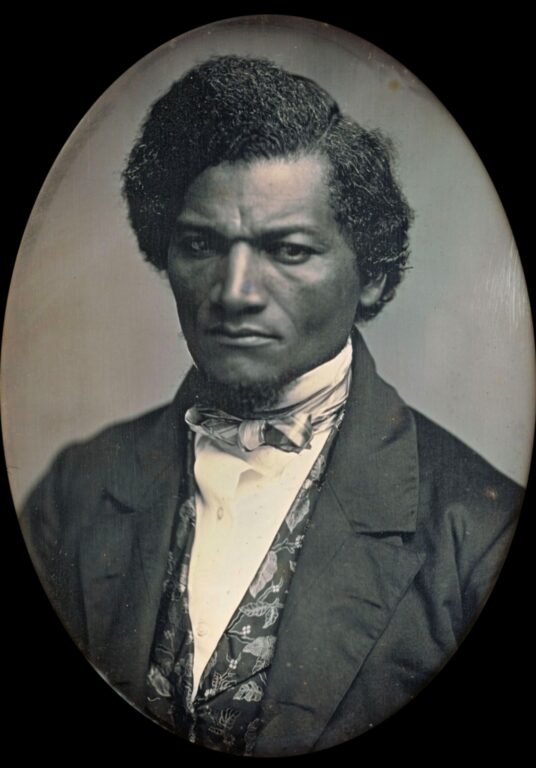
A letter to the Editor of the Freeman’s Journal, on the 3rd September 1845, contained the following: ‘Mr Brennan, who is much devoted to the cause of teetotalism, induced Father Spratt to hold a meeting at Celbridge, notices of his intention to do so were posted up some days beforehand, and the consequence was that the entire population of that district were in motion yesterday, and at three o’clock a great concourse of people assembled in a field a short distance from the village … Our meeting at Celbridge was rendered remarkable by the presence of Frederic Douglass … Mr Douglass is a fine looking man, possessed of a full flow of natural eloquence, which must make him a popular orator before any audience.’
Douglass, who had only recently escaped the bonds of slavery, had a huge effect on his Irish audience. Likewise, the time Douglass spent touring Ireland, was very impactful on the man himself. Patricia J. Ferreira, in her 2001 paper, Frederick Douglass in Ireland: The Dublin Edition of His “Narrative”, explains why Douglass’ time in Ireland was so important to him, and helped shape the monumental figure he would go on to become: ‘While his contact with the Irish profited Douglass during his formative years, his abolitionist speaking tour through Ireland later in his life gave him firsthand experience with the indigenous Irish and also rejuvenated his sense of the valuable contribution that words can make to larger political transformation. Douglass was particularly taken with the skillful oratory of Daniel O’Connell … his relationship with members of the Hibernian Anti-Slavery Society, considered the most ardent abolitionists in Europe, and his contact with ordinary Irish citizenry in Ireland, who for the most part heartily received him and his mission, assisted his capacity to write of his own experiences in slavery.’ It is almost as if Douglass’ time in Ireland, and his reception here, helped him deal with the trauma he was carrying, and afforded him the mental space to formulate his response to it.
Central to Douglass’ reception and transformation, was a Ballitore educated Quaker, Richard Davis Webb. As Ferreira recounts: ‘… Douglass’s association with an Irish publisher Richard D. Webb was another crucial relationship that he established while in Ireland. More than other members of the Hibernian Anti-Slavery Society, Webb was responsible for organizing and scheduling Douglass’s speaking engagements.’ As well as organising Douglass’ speaking engagements around the island, Webb utilised his profession to assist his cause: he printed the Irish Edition of Douglass’ Narrative. This had the effect of spreading word of what Douglass was trying to accomplish: the abolition of slavery in America; but crucially, it also assisted Douglass in providing for his family. Copies were available to purchase at venues where he spoke. As Ferreira states: ‘…Webb reported that Douglass earned $750 from sales of the first Dublin edition. When the version sold out, Webb began production of 2,000 more copies for the 1846 edition.’
In Richard Davis Webb: Dublin Quaker Printer (1805-72), author Richard S. Harrison explains some of Webb’s backstory. His early schooling was in Mountmellick, but ‘On his own request he was sent to the well-known private Quaker school of Ballitore in County Kildare … Ballitore school was remarkably liberal and enlightened in its approach to education. Webb appreciated the easy and relaxed atmosphere. The boys kept pets and cultivated their own garden plots.’
An Irish genealogical source : the role of the Quaker school at Ballitore, County Kildare, by E.J. McAuliffe, contains a record of Webb’s time at Ballitore school:

It was during his time in Ballitore that Webb struck up a life-long friendship with Mary Leadbeater. Harrison states that Leadbeater was very impressed by the assiduous Webb, and the sentiment was reciprocated beyond Webb’s time at the school: ‘The feeling of affection was reciprocated by Webb who maintained a correspondence with her … Mary Leadbeater used to ask him to arrange for copies of her own books to be bound by his employer … Whenever Mary Leadbeater was in Dublin, Webb would visit her at her lodgings in Parliament Street.’
The relationship between Douglass and Webb was not always plain sailing. Webb had a frank and forthright approach to his dealings with Douglass, and this lead to disagreements between the two, mostly over the finer details of printing Douglass’ Narrative. Understandably, Douglass was protective over his work, and his vision for how it was to be presented to the public. As Ferreira recounts: ‘The Irish printer, however, did not have a free hand in publishing the text. Correspondence between Webb and Douglass suggests that Douglass was intimately involved in the Narrative’s printing.’
Thus, a man who corresponded with, spoke to, and influenced Abraham Lincoln on the abolition of slavery, who inspired generations to come (not least one President Obama), was helped in no small way on his journey by a Quaker educated by the riparian banks of the Griese.
By Kevin Dowling, Kildare County Archives and Local Studies.
