The Grand Hotel, Robertstown
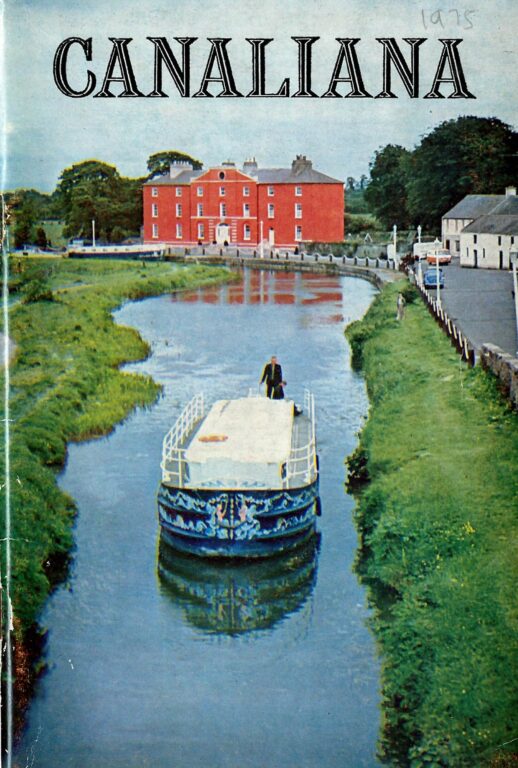
This image is from Canaliana, which was a Bulletin published by Robertstown Muintir na Tíre. It is in our collections in Local Studies.
In a foreword to the 1965 edition, the purpose of the booklet and festival is made clear: ‘The object of holding a Grand Canal festa at Robertstown can be explained quickly and in a straightforward manner … to raise funds in order to restore the old hotel to something of its former importance and elegance.’
The significance of the hotel to Robertstown is huge, and the story of why it was built there is an interesting one. The 1967 publication of Canaliana contains a piece by Eileen Ryan: ‘The Grand Hotel at Robertstown, built on a lavish scale in 1801, so pleased a traveller, Sir John Carr in 1803, that he described it as “A Noble Inn”. It was one of a series of huge hotels built by the Company.’
In tandem with the outlay of the canal, the Grand Canal Company set out on a hotel building frenzy: Portobello, Sallins, Robertstown, Tullamore and Shannon Harbour, the ‘motorway plazas’ of their time.
Freemans Journal, April 4, 1811:

Because of its distance from Dublin, the Robertstown Hotel was positioned perfectly to attract guests for a stop-over on their way westwards. You can picture them alighting from the half-submerged gloom of the boat, and making their way up the hotel’s graceful steps. A day spent taking in the sights of the midlands from watery perch guaranteeing a healthy appetite.
In a series of articles in Canaliana, Ruth Delaney passed some observations on the hotel’s finances and menu: ‘Business was good; in 1802 the receipts from the hotel amounted to £570. 9s 6d. and the expenditure…was £272. 6s. 5d… [the hotel] was authorised to receive two baskets by the passage boats each day…one to contain not more than 6s. worth of bread, the other 400 oysters, for the use of the passengers in the said hotel’
The good fortunes of the Grand Canal Hotel in Robertstown weren’t to last, unfortunately. The hospitality business, then as now, wasn’t an easy one. As Ruth Delaney describes it, after a busy opening period, ‘the 72 windows and 62 hearths of the hotel were gradually closed up to avoid tax. After the second period of retrenchments only 31 windows and 19 hearths remained open, reducing the number of sleeping apartments to eleven. The windows were stopped by painting the shutters black and erecting a wall behind them; this was easily removed if more rooms were needed.’
The life of the building as a hotel ceased in the mid nineteenth century. In the years since it has had many lives: an R.I.C. barracks, a Bord Na Móna billeting camp, a youth hostel.
The hotel’s Crosthwaite clock remains today as a reminder of its former elegance, keeping a watchful eye on goings on below.

By Kevin Dowling, Kildare County Archives and Local Studies.
