Kildare Wallpaper Factory
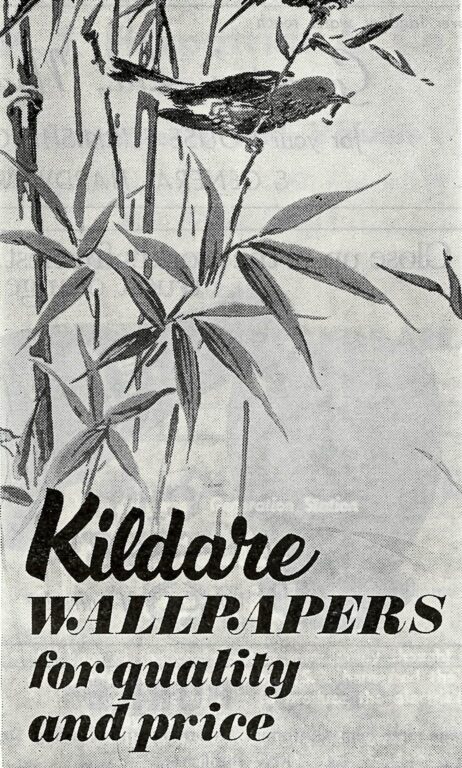
The Evening Herald, on July 3, 1936, announced that: ‘The new Free State wallpaper factory is to be established in Kildare town … A most suitable site has been acquired at Crosskeys on the outskirts of the town. The factory buildings, which will cover two statute acres, will be erected at a cost of £12,000…’
This ambitious project was not just a vote of confidence in the town, it was also a much needed source of local employment. With tariffs to be imposed on imported wallpaper, there were grumblings that consumer choice would be adversely affected. Minister for Industry and Commerce, Seán Lemass, was keen to point out that: ‘[while] it was true that the manufacture of wallpapers here would reduce the number of lines available to the trade … he did not anticipate that the restriction in the number of designs would restrict the use of wallpaper in the country.’ (Irish Independent, Nov 20, 1936)
On one level, this is a simple story of the Free State attempting to become more self-sufficient. But, when you think about it, the wares being produced on the main Dublin to Cork road had both decorative and subliminal purposes. From this point on, every time politics was discussed around the dinner table, or when people visited their neighbours for a chat, there was a good chance it would all happen in a room draped in ‘Free State’ wallpaper.

(Image from Kildare Local Studies postcard collection)
In the 1970s, the business faced both opportunities and challenges. As Ireland geared up to join the Common Market, it was realised that ‘homespun’ industries like the Wallpaper Factory would face stiff competition: ‘…the wallpaper factory was designed for production for the home market. The workers of Kildare would have to assist the country in every way to deal with the challenge of the Common Market.’ (Nationalist & Leinster Times, February 13, 1970).
And, of course, looming on the horizon was the oil crisis and increases in the costs of production. Factory management put it succinctly: ‘After last year’s budget, we had to bear an extra £15,000 cost for oil, of which we use 800 gallons a day.’ (Nationalist & Leinster Times, February 4, 1977).
The Leinster Leader reported on 12 July 1980 that Kildare Wallpapers was to close. Listing all the challenges that the business had faced, it concluded: ‘Regrettably, this entails the closure of all aspects of the company’s activities in Kildare.’
By Kevin Dowling, Kildare County Archives and Local Studies.
